 My guy and I went to visit our adorable grandson. We made a few stops and we visited Barriefield Antiques just outside of Kingston for the first time.
I saw this set and was intrigued by the etch, although I had no idea of their provenance.
I posted them on the Elegant and Everyday Glass Forum and, as usual got a quick hint. In the interim I found a brief reference in The Collector’s Encyclopedia of Pattern Glass by Mollie Helen McCain.
Further online searching verifies the ID with this:
“A new pattern has been identified by Hobbs, Brockunier. The following appeared in the first issue of All About Glass.
Oasis Etching by Tom Bredehoft (Reprinted from All About Glass Vol. I No. 1 with permission)
 For many years collectors and students of 19th century glass have puzzled over what appeared to be three different etched designs. Goblets showed a standing camel, a reclining camel and many tall palm trees. Compotes showed a camel caravan. These were dubbed Camel Caravan. Creamers have two scenes: one, a horse laden with three barrels, another with a female figure drawing water from a well—both having palm trees. Spoon holders show a horse and rider racing past small buildings. Sugars show another horse and rider. Celeries show an Egyptian with a seated female under a palm tree. The lid to the butter has three pyramids. Some of these pieces were called Tropical Villa, others Oasis. All these puzzling pieces had seemingly related designs, but different motifs. This caused collectors and dealers alike confusion, and it appeared that each was part of a different pattern.

Similar designs on different patterns of glass were another part of the puzzle. Most pieces have a pressed foot, stem and lower part of the bowl in common, while the goblet has a plain foot, a stem with a round knob in the middle and the pressed pattern on the lower part of the goblet bowl, similar to that of other pieces.
The last part of the puzzle was than none of these etched designs could be attributed to a specific manufacturer.
A July 21, 1881 issue of Crockery and Glass Journal sheds considerable light on the above puzzles. To quote in part:
“J. H. Hobbs, Brockunier & Co….Two new designs in etching: one of Egyptian character—are particularly striking. The celery represents an Arab in fez and sash, dismounted from his spirited horse, talking to a maiden seated under a palm by the ruins of an old temple. The water pitcher represents the drawing of water from the well, with a female beautiful and graceful enough to be ‘Rebecca,’ with a jar on her head and a camel laden for its desert journey. The bowl represents boating scenes on the Nile….”
 With this trade quote, the puzzle of who made Camel Caravan (and all the other named patterns) is put to rest. The descriptions given correspond with the designs found on actual pieces, although some editorial liberties are taken describing some of the people. Now that the etching has been identified, the glass on which it appears can also be credited to Hobbs, Brockunier of Wheeling, WV. The unique pressed stem and foot of many pieces can now identify undecorated pieces as being made by Hobbs, Brockunier.
Rather than have three different names for the same pattern (and maybe more!), it seems that Oasis is the best choice, describing the designs found on most of the pieces. Camel Caravan and Tropical Villa should be abandoned in favor of Oasis.
During this period several companies made patterns, either etched or pressed, in which only a few motifs were consistent in all pieces of the pattern. Hobbs, Brockunier & Co. made a similarly styled pattern in 1880 called Flamingo Habitat. In this pattern, too, the etched designs vary from piece to piece, causing several to be considered parts of different patterns. No. 77 pattern was used for most pieces of Flamingo Habitat.
Both Flamingo Habitat and Oasis were etched designs done by exposing the glass to fumes of hydrofluoric acid rather than the later process of immersing the glass into the acid itself. Therefore, the Oasis and Flamingo Habitat pieces are etched only slightly, leaving a smooth surface, while later plate etched glass has a much more deep effect which is somewhat rough to the touch.
Oasis is known in forms indicating a complete table service. Items known are:
Table Set:
Covered butter, Cream, Spoon, Sugar, Compote 7″(across), Compote, large, Goblet, Pitcher 3 pint (blown), Tumbler (pressed), Pitcher 2 quart (blown), Celery, Berry bowl large and Berry bowl small
Bibliography
Bredehoft, Tom and Neila, Hobbs, Brockunier & Co. Glass, Collector Books, 1997
Kamm, Minnie Watson, An Eighth Pattern Glass Book, Privately Published, 1954, 1970
Metz, Alice Hulett, Much More Early American Pattern Glass (Book II), Collector Books, 1978
Mordock, John B. American and Canadian Early Etched Goblets, Collector Books, 1985, 1991
Unitt, Doris and Peter, American and Canadian Goblets, For the Love of Glass Publishing, Inc., 1971, 1994
Welker, John & Elizabeth, Pressed Glass in America, Antique Acres Press, 1985″
I still have my Flamingo comport and a sugar bowl by Hobbs and Brockunier that I don’t think I have ever posted. Great solid pieces. I have travelled to Egypt when I lived in Africa and these pieces appeal to me. I am pleased to have an ID.
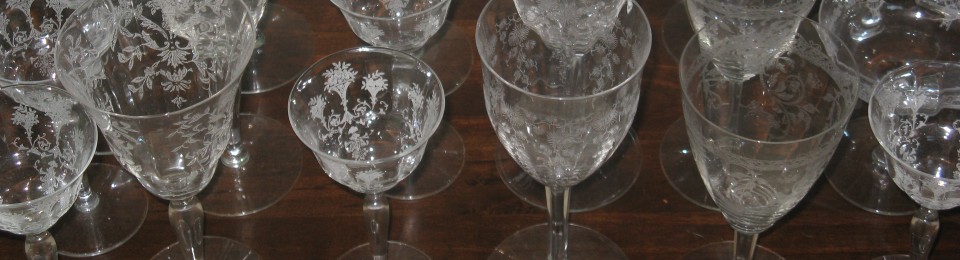
 These two stems are not really my ‘thing’. I picked them up at a Value Village and figured, once I saw the Waterford mark, that they would be identifiable.


