• American Glass Associations
  • Canadian Glass Associations
  • Carnival Glass References
  • European Glass Sites
  • Facebook Glass Groups
  • Glass Marks
  • Glass Reference Sites
  • Image Gallery (I have owned, all but two of these items)
  • Organizations / Individuals with a Specific (non-stem) Glass Focus
  • Questions About Reproductions ? – sites to investigate

Granny's Glasses

~ Let's talk vintage crystal/elegant glass/glass, share pattern IDs and enjoy the shared pleasure of collecting.

Granny's Glasses

Tag Archives: Coloured Glass

Central Glass Dish with Hester (?) Etch or Imperial Love Bird (?)

15 Sunday Feb 2015

Posted by d.b. in Central, Imperial

≈ Leave a Comment

Tags

Amber Glass, Animals in Glass, Birds, Colored Glass, Coloured Glass, Floral Etch, Mayonnaise Dish, Plate Etched, Topaz Glass

Central Glass 432 (3)I am sitting in my little office on the second floor of our house.  I can see snow on the roofs out the window.  The window is freezing up and the wind is howling.  It is very cold outside.  I am happy to be inside with my little hobby.  I doubt that I will venture out today.

Last weekend however, we made a trip to Around the Block.  What a great store!!!!  I only picked up a couple pieces and this was one.  The rich dark topaz/amber caught my eye, as did the pretty shape and the dainty etch.

There is some confusion around its identification.  I found a sample of the etch fairly easily – Central Glass’ etch #432 Hester.  I only have one reference book – Tim Schmidt’s Central Glass Works: the Depression era and I couldn’t find the blank.  I posted a query on The Elegant and Everyday Glass Forum asking for a line number. Someone suggested that this piece was a mayonnaise dish and was instead made by the Imperial Glass Company – Etch DE 432 – Love Bird.   The line numbers are so close!

From Schmidt’s book he quotes an  article in the Crockery and Glass Journal, March 1940:

“The equipment of the Central Glass Works, Wheeling W. Va., was acquired by the Imperials Glass Corp., who will transfer most of it to Bellaire, Ohio, where the plant is situated.”Central Glass 432 (5)

Central ceased operations in 1939.  It is not inconceivable that this piece was produced by Imperial if it assumed Central’s molds and etching plates.

I hope someone who knows more than me (almost everyone) will provide some information.  In the mean time, this is a very pretty piece.

Fire King Jadeite / Jadite Bowl

21 Sunday Sep 2014

Posted by d.b. in Anchor Hocking

≈ Leave a Comment

Tags

Bowl, Coloured Glass, Fire King, Green Glass, Jadeite, Jadite

Fire King Jadeite BowlI picked up this little bowl somewhere.  It is intended to travel out to British Columbia when I go visit my daughter.  I bought her a piece of Mckee awhile back and thought she would like this little bowl.

I don’t know anything about jadeite pieces.  I do know that there are alot of reproductions on the market.  I have no reference texts to validate any pieces.

It is marked with Fire King’s mid to late 1950s mark, according to this ebay article – Buying Fire King Jeannette Jadite Jadeite.  Fire KIng Jadeite Bowl 2I don’t know if marks have been reproduced or not.  So…its origin remains unknown.

In any event, I paid less than $5.00 for this little bowl, my daughter will love it regardless, so it doesn’t really matter.

German Toasting Glasses – Roemer Glasses

14 Sunday Sep 2014

Posted by d.b. in Uncategorized

≈ Leave a Comment

Tags

Coloured Glass, Etched Glass, Grapes, Green Glass, Roemer

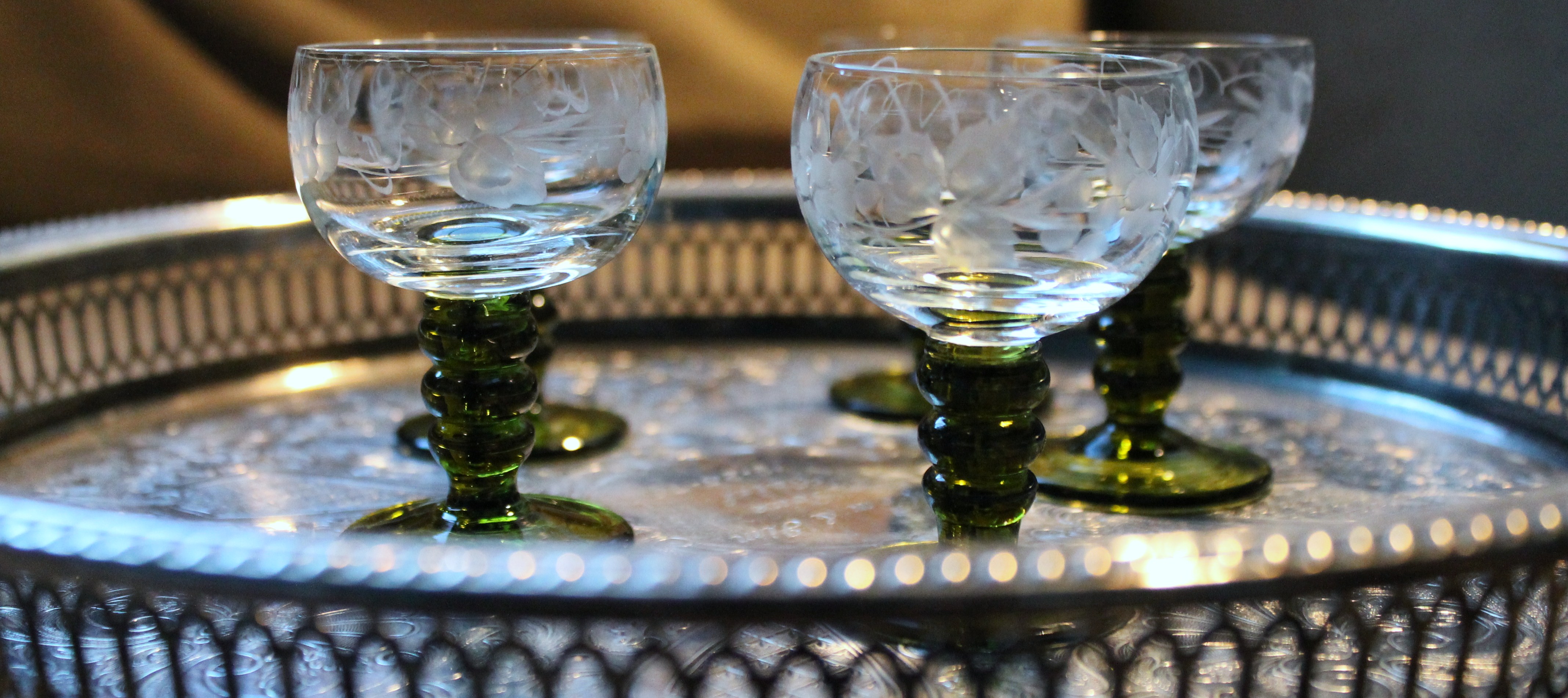
German glasses (3)These little stems aren’t my usual choice.  But they are sturdy and attractive.  They’re not uncommon and can be seen frequently with and without the etch.  They also have amber stems with slightly different patterns.

No idea who actually made them.  Similar glasses are frequently advertised as Roemer Glass.  But I don’t think this is the name of the manufacturer.

This is an interesting explanation of Roemer Glass from Deutsches Haus:

“The History of Roemer Wine Glasses

The knowledge of how to make glass began in the Middle East around 4500 B.C. Glass first started out in the form of beads and then around 1700 B.C. it took on the shape of a hollow container.

During this time, the Roman Empire had set up glass works in Italy, France and the Rheinland. By the 2nd century, glass works had spread to Spain, Belgium, the Netherlands, Switzerland and Britain. At this time, the wine glass was in the shape of a hollow vessel with no stem, but had large melted beads of glass that protruded from the outisde glass area which made it easier to hold on to.

By the 4th century, and with the collapse of the Roman Empire, glass shapes began to take on a more regional identity and because of the sand in different areas, the color of the glass would sometimes be different. “Forest Glass” which was made from forest potash and a sand that contained iron impurities was being produced in France. This is where the green color started and for many years, the entire wine glass was green.

The word “Römer” was derived from the Latin word “Roma, for Rome and dedicated to the romans who initially brought the first grape vines into Germany. It also refers to the custom of using this style of glass to toast the Holy Roman Emperor. Today, in Germany, the Roemer is regarded as a traditional toasting glass.

Over the years, wine glasses started to look more sophisticated. Engraving was added to the bowls for the decorations and sometimes gold was added to the rims. Wine connoisseurs started recommending that wine should be served in a clear wine glass, and eventually, just the stems were kept green. It was also thought that the green stems would reflect the color of the pale wines of the regions into the clear bowls.

France had a large influence in the design of these wine glasses, particularly from the province of Alsace which is just across the Rhine from Germany. Alsatians produced two traditional white wines – rieslings and gewürtztraminers. These wines were and continue to be bottled in green bottles and served in special glasses with clear bowls and green stems. In many countries, a wide bowl on a wine glass is usually thought more suited for red wines, however, the Alsatians thought it was the best way to bring out the floral scent of the white wines.

Today, roemer wine glasses are still considered a traditional toasting glass and most popular in Germany. They are still used to serve white wines and seen all over Germany.”German glasses

So…it would appear that my little glasses were intended to be toasting glasses, made in Germany and likely not too old.

 Here is a blog with some interesting photos and some further information – Ancient Glass Blog of the Allaire Collection.

← Older posts
Newer posts →

♣ Categories

♣ Recent Comments

  • d.b. on Image Gallery (I have owned, all but two of these items)
  • d.b. on Unknown Green Glass Swan Needs Identifying!
  • d.b. on Vallerysthal Pineapple Footed Bowl
  • Bob on Unknown Green Glass Swan Needs Identifying!

♣ Grannys Glasses on Etsy

https://www.etsy.com/ca/shop/GrannysGlasses?ref=search_shop_redirect

Proudly powered by WordPress Theme: Chateau by Ignacio Ricci.