• American Glass Associations
  • Canadian Glass Associations
  • Carnival Glass References
  • European Glass Sites
  • Facebook Glass Groups
  • Glass Marks
  • Glass Reference Sites
  • Image Gallery (I have owned, all but two of these items)
  • Organizations / Individuals with a Specific (non-stem) Glass Focus
  • Questions About Reproductions ? – sites to investigate

Granny's Glasses

~ Let's talk vintage crystal/elegant glass/glass, share pattern IDs and enjoy the shared pleasure of collecting.

Granny's Glasses

Tag Archives: Roemer

German Toasting Glasses – Roemer Glasses

14 Sunday Sep 2014

Posted by d.b. in Uncategorized

≈ Leave a Comment

Tags

Coloured Glass, Etched Glass, Grapes, Green Glass, Roemer

German glasses (3)These little stems aren’t my usual choice.  But they are sturdy and attractive.  They’re not uncommon and can be seen frequently with and without the etch.  They also have amber stems with slightly different patterns.

No idea who actually made them.  Similar glasses are frequently advertised as Roemer Glass.  But I don’t think this is the name of the manufacturer.

This is an interesting explanation of Roemer Glass from Deutsches Haus:

“The History of Roemer Wine Glasses

The knowledge of how to make glass began in the Middle East around 4500 B.C. Glass first started out in the form of beads and then around 1700 B.C. it took on the shape of a hollow container.

During this time, the Roman Empire had set up glass works in Italy, France and the Rheinland. By the 2nd century, glass works had spread to Spain, Belgium, the Netherlands, Switzerland and Britain. At this time, the wine glass was in the shape of a hollow vessel with no stem, but had large melted beads of glass that protruded from the outisde glass area which made it easier to hold on to.

By the 4th century, and with the collapse of the Roman Empire, glass shapes began to take on a more regional identity and because of the sand in different areas, the color of the glass would sometimes be different. “Forest Glass” which was made from forest potash and a sand that contained iron impurities was being produced in France. This is where the green color started and for many years, the entire wine glass was green.

The word “Römer” was derived from the Latin word “Roma, for Rome and dedicated to the romans who initially brought the first grape vines into Germany. It also refers to the custom of using this style of glass to toast the Holy Roman Emperor. Today, in Germany, the Roemer is regarded as a traditional toasting glass.

Over the years, wine glasses started to look more sophisticated. Engraving was added to the bowls for the decorations and sometimes gold was added to the rims. Wine connoisseurs started recommending that wine should be served in a clear wine glass, and eventually, just the stems were kept green. It was also thought that the green stems would reflect the color of the pale wines of the regions into the clear bowls.

France had a large influence in the design of these wine glasses, particularly from the province of Alsace which is just across the Rhine from Germany. Alsatians produced two traditional white wines – rieslings and gewürtztraminers. These wines were and continue to be bottled in green bottles and served in special glasses with clear bowls and green stems. In many countries, a wide bowl on a wine glass is usually thought more suited for red wines, however, the Alsatians thought it was the best way to bring out the floral scent of the white wines.

Today, roemer wine glasses are still considered a traditional toasting glass and most popular in Germany. They are still used to serve white wines and seen all over Germany.”German glasses
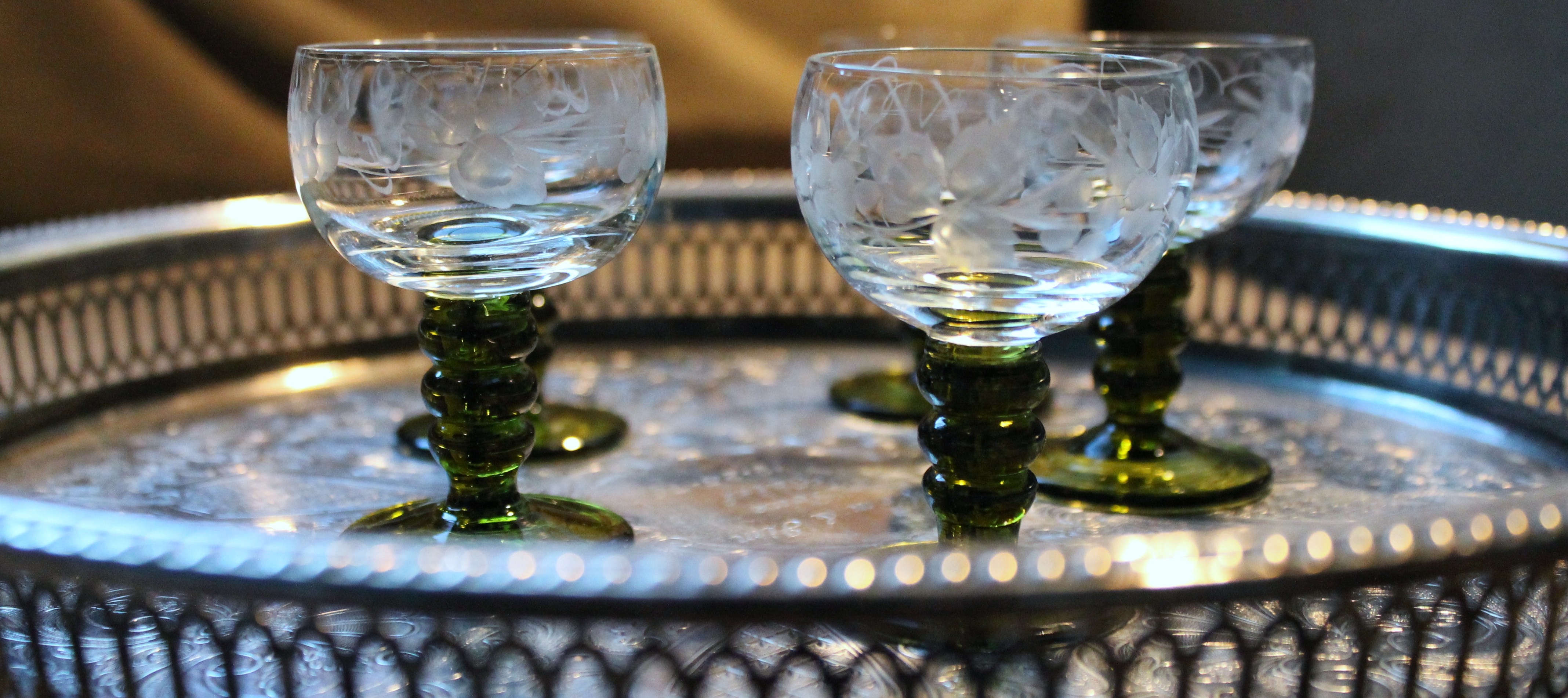
So…it would appear that my little glasses were intended to be toasting glasses, made in Germany and likely not too old.

 Here is a blog with some interesting photos and some further information – Ancient Glass Blog of the Allaire Collection.

♣ Subscribe

  • Entries (RSS)
  • Comments (RSS)

♣ Archives

  • January 2024
  • December 2023
  • April 2023
  • December 2022
  • September 2022
  • July 2022
  • June 2022
  • April 2022
  • March 2022
  • February 2022
  • January 2022
  • December 2021
  • November 2021
  • October 2021
  • September 2021
  • July 2021
  • June 2021
  • April 2021
  • March 2021
  • February 2021
  • January 2021
  • December 2020
  • November 2020
  • October 2020
  • September 2020
  • August 2020
  • July 2020
  • June 2020
  • May 2020
  • April 2020
  • March 2020
  • December 2019
  • October 2019
  • September 2019
  • August 2019
  • July 2019
  • May 2019
  • April 2019
  • March 2019
  • January 2019
  • November 2018
  • October 2018
  • September 2018
  • August 2018
  • July 2018
  • June 2018
  • May 2018
  • April 2018
  • March 2018
  • February 2018
  • January 2018
  • December 2017
  • October 2017
  • September 2017
  • August 2017
  • July 2017
  • June 2017
  • May 2017
  • April 2017
  • March 2017
  • February 2017
  • January 2017
  • December 2016
  • November 2016
  • October 2016
  • September 2016
  • August 2016
  • July 2016
  • June 2016
  • May 2016
  • April 2016
  • March 2016
  • February 2016
  • January 2016
  • December 2015
  • November 2015
  • October 2015
  • September 2015
  • August 2015
  • July 2015
  • June 2015
  • May 2015
  • April 2015
  • March 2015
  • February 2015
  • January 2015
  • November 2014
  • October 2014
  • September 2014
  • August 2014
  • July 2014
  • June 2014
  • May 2014
  • April 2014
  • March 2014
  • February 2014
  • January 2014
  • December 2013
  • November 2013
  • October 2013
  • September 2013
  • August 2013
  • July 2013
  • June 2013
  • May 2013
  • April 2013
  • March 2013
  • February 2013
  • January 2013
  • December 2012
  • November 2012
  • October 2012
  • September 2012
  • August 2012
  • July 2012
  • June 2012
  • May 2012
  • April 2012
  • March 2012
  • February 2012
  • January 2012
  • August 201

♣ Categories

  • Anchor Hocking
  • Avon
  • Baccarat
  • Bayel
  • Boda
  • Bohemia
  • Bohemia Crystal
  • Book
  • Boule
  • Boy's Crystal Art Glas
  • Boyd's Crystal Art Glass
  • Bryce
  • Cambridge
  • Central
  • Co-operative Flint
  • Colony
  • Consolidated Lamp & Glass Company
  • Corning
  • Cristal D`Arques
  • Czechoslovakian
  • Diamond Glass-Ware Company
  • Ditheridge & Company
  • Dominion
  • Dorflinger
  • Doyle
  • Duncan & Miller
  • E. O. Brody
  • Edinburgh Crystal
  • Empoli
  • Farber Bros.
  • Federal
  • Fenton
  • Fire King
  • Fostoria
  • Fry
  • George Zimmer
  • Gillinder & Sons
  • Glastonbury Lotus
  • Goebel
  • Hazel-Atlas
  • Heisey
  • Hobb and Brockunier
  • Hocking
  • Hughes
  • Huntington
  • Imperial
  • Indiana Glass
  • Inwold Glassworks
  • Jeannette
  • Jefferson Glass
  • L.E. Smith
  • L.G. Wright
  • Lamont
  • Lancaster
  • Libbey
  • Lotus Glass
  • Louie
  • Macbeth-Evans
  • Maryland Glass
  • McKee
  • McKee & Company
  • Meissen
  • Monongah
  • Morgantown
  • New Martinsville
  • Northwood
  • Ohio Flint Glass
  • Paden City
  • Pairpoint
  • Pall Mall Glass
  • Portieux Vallerysthal
  • Pyrex
  • Reference Guide
  • Reproductions
  • Richards & Hartley
  • Royal Doulton
  • S. Reich & Co.
  • Saint Louis
  • Seneca
  • Sheriff
  • Standard Glass
  • Stuart
  • Supreme Aluminum Products
  • Thomas Webb
  • Tiffin
  • U.S. Glass
  • U.S. Glass Factory B
  • U.S. Glass Factory C
  • Uncategorized
  • United Chromium
  • United States GLass
  • Unknown
  • Unknown Cuts
  • Unknown Engravings/Etches
  • Unknown Pressed
  • Utility Glass Works
  • Val St. Lambert
  • Vallerysthal
  • Viking
  • W.J. Hughes
  • Walther
  • Waterford
  • Webb Corbett
  • West Virginia Glass Specialities
  • Westmoreland
  • Wheeling

♣ Meta

  • Log in

Proudly powered by WordPress Theme: Chateau by Ignacio Ricci.