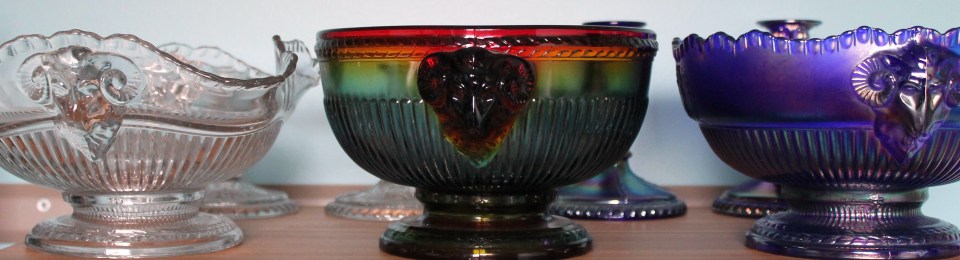
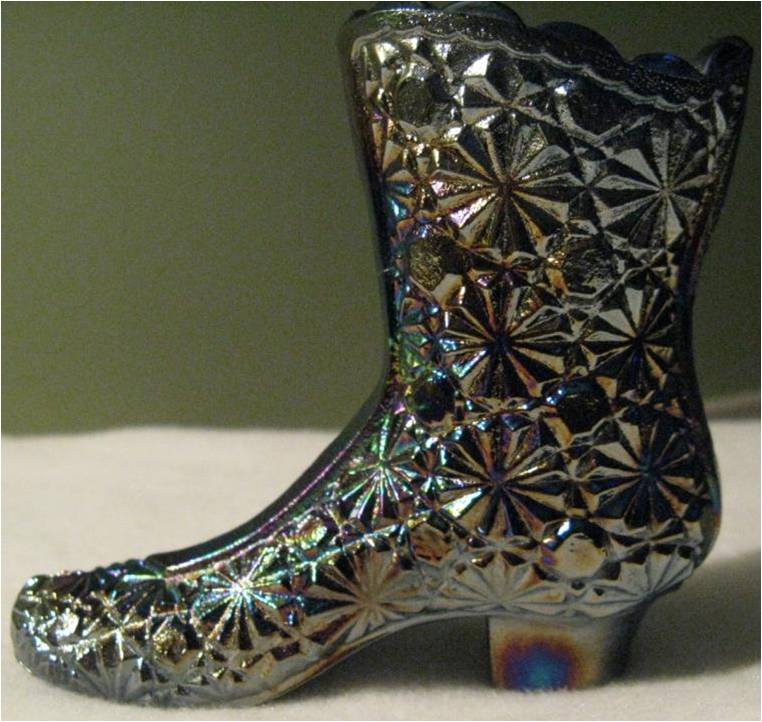
I’ve seen this glass finish referred to as ‘slag’. I’m not all that fussy on it and likely will not buy other pieces, but I thought the colours were different in the shoe. I don’t know if it really is but, read about slag below.
From Collector’s Weekly :
“Slag glass, also known as marble glass or malachite, is a type of opaque, streaked pressed glass. Production of slag glass originated in late-19th-century England, where glass manufacturers are thought to have added slag from iron-smelting works to molten glass to create a range of effects—from tortoiseshell to marbling. Among other uses, slag glass was a popular material for lampshades.
One of the first glass foundries to produce slag glass (although it was not called that at the time) was the Gateshead, England, firm of Sowerby, which patented its recipe for purple malachite glass in 1878. Sold into the U.S. market as “blackberries and cream,” this popular formula was followed by other malachite colors, including a lemon-yellow called Giallo, a drab green called Pomona, a blue malachite called Sorbini, and Sowerby’s famous Brown, which is very difficult to find today.
Since the process of making slag glass was shrouded in a certain amount of mystery, stories sprang up to try and account for the process behind the effects. For example, it was a good bet that Sowerby’s Blue Nugget color of 1883 was the result of adding cadmium to molten glass, but how to explain Gold Nugget? Stories soon spread that John George Sowerby, son of the company’s founder, was tossing gold sovereigns into batches of amber glass to create this dramatic hue.
In the United States, manufacturers such as Westmoreland and Akro Agate picked up on the techniques developed in England and produced their own versions of slag glass. As in England, one of the most popular applications for their pressed opaque glass was in lampshades. Wide bands of creamy colors allowed the light source in a lamp to fill a room with a soft ivory glow, while the purples and greens and reds pieced together in detailed leaded shades resulted in multi-colored illumination.
Just about anyone who was making lamps during the Art Nouveauperiod, from Tiffany to Roycroft to Steuben, might have used slag glass in their shades. But whether they did or not in a particular lamp is another matter. The problem is that today, “slag glass” is used rather casually by dealers and collectors alike to refer to almost any type of pressed opaque glass containing colored swirls or streaks. The key to determining if a piece of glass is “true” slag or just a handsome example of pressed glass is to look for glass that is obviously and richly marbled rather than simply colored or streaked.”