• American Glass Associations
  • Canadian Glass Associations
  • Carnival Glass References
  • European Glass Sites
  • Facebook Glass Groups
  • Glass Marks
  • Glass Reference Sites
  • Image Gallery (I have owned, all but two of these items)
  • Organizations / Individuals with a Specific (non-stem) Glass Focus
  • Questions About Reproductions ? – sites to investigate

Granny's Glasses

~ Let's talk vintage crystal/elegant glass/glass, share pattern IDs and enjoy the shared pleasure of collecting.

Granny's Glasses

Tag Archives: Platter

Update – previous postings – Jeannette Glass – Floragold – Louisa

26 Sunday Mar 2017

Posted by d.b. in Jeannette

≈ Leave a Comment

Tags

Blue Glass, Coloured Glass, Comport, Compote, EAPG, Floragold, Floral, Louisa, Marigold Glass, Pattern Glass, Platter, Pressed Glass, Sugar bowl, Tray


Pretty covered sugar bowl.


———————————————————————————————————February 15, 2016
IMG_5405


Came across this pretty platter in the Marigold.  Absolutely pristine.  Very pretty.

—————————————————————————————–

Update to the original February 28, 2012 post.

I have joined a Facebook group called Depression & Vintage Glass ID.    I enjoy his trolling the posts and was very happy to see that one of the members has posted this exact Depression & Vintage Glass ID.  compote.

I was surprised to discover that this is a piece of Floragold by Jeannette (circa 1940s-1960s).  I had always assumed that Floragold meant that the pieces would be amber/marigold in colour.  Turns out that the Floragold refers to the floral pattern in the centre.  The pieces are also commonly called Louisa.  Here’s an explanation from AllExperts: Collectibles-General (Antiques)/Floragold aka Louisa eapg.

“Westmoreland Glass made Louisa in Carnival glass originally.  Jeannette bought the moulds from Westmoreland.  If you go to http://www.ddoty.com/ and type in “Louisa” you will see a history of this lovely pattern.

Floragold was one of Jeannette’s most extensive patterns. It has a Depression glass look with its mold-etched flower design. The shapes are interesting and combine square bases with rounded shapes and ruffled rims. Floragold is a fun pattern to collect because it came in so many shapes and pieces. You can put together a complete dinner or lunch set, including dishes, bowls, cups, saucers and tumblers. Serving pieces include pitcher, several bowls, platter and shakers. Floragold has ruffled and plain bowls in several sizes ranging from sauce dishes to larger console-size.

While most pieces come in iridescent, you can find some clear pieces and there is a comport in Ice Blue. ”

A poster from the Depression & Vintage Glass ID indicated that the blue pieces were only sold at a store named Krogers.

I am happy to know where this piece came from.  Where it is now is in question.  Probably in the garage.

_________________________________________________________________

This is a weighty piece of light blue glass with a pattern at the bottom of the bowl.  Can’t recall where I even got this, although I remember I had to reach up high to get it!  I have a number of compotes/comports, and candy/nut dishes.  I mostly put candles or seashells in them.  The trouble is that they take up so much storage space.  This one is of a good size to put fruit in.  Funny though…the prettiest part of the design is the interior pattern.  Once you put something in it – like fruit – the pattern is covered up.  I suppose glass designers know way more than me, but this doesn’t make sense.

Macbeth-Evans Pink Salver in the American Sweetheart Pattern

05 Sunday Feb 2017

Posted by d.b. in Macbeth-Evans

≈ Leave a Comment

Tags

Colored Glass, Coloured Glass, Depression, Floral, Pink Glass, Platter, Salver


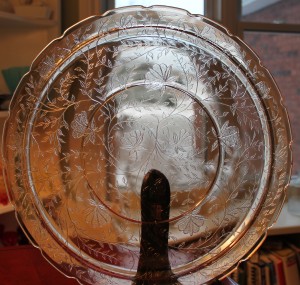
I normally don’t fall for pink glass, and neither am I a big buyer of non-Elegant Depression glass.  But the design on this piece was pretty.  I have tried to show the centre although it is hard to see.  But it reminds me of a great, big snowflake and, despite my aversion for snow and winter, ( it is snowing and blustery as I type!), I liked the pattern!

I didn’t know what it was, but my handy dandy Warman’s Depression Glass field guide had the pattern on page 57 (3rd edition).  According to Warman’s the manufacturing range listed was 1930-1936.  Colours produced included blue, Monax, pink and red. Limited production in Cremax and colour-trimmed Monax.

This is the 12 inch salver.

Here’s an interesting article about American Sweetheart by Kathy Eickholt on the National Depression Glass Association website.

I don’t think that I have knowingly owned anything else by Macbeth-Evans of Charleroi, Pennsylvania.  And…..I didn’t know where Charleroi is.

According to Wikipedia:

“Charleroi (/ˈʃɔːlərɔɪ/ shaw-lə-roy) is a borough in Washington County, Pennsylvania, along the Monongahela River, 21 miles south of Pittsburgh.[ Charleroi was settled in 1890 and incorporated in 1891.[2] The 2010 census recorded a population of 4,120.”

For a brief history of the company check out this post on The Lampworks’ website.  As an aside, I found The Lampworks’ site to be interesting on its own.  I hope that I am able to visit some day.


Anchor Hocking Fire-King Devilled Egg Tray – Delphite

26 Saturday Mar 2016

Posted by d.b. in Anchor Hocking

≈ Leave a Comment

Tags

Blue Glass, Colored Glass, Coloured Glass, Delfite, Delphite, Egg Tray, Platter

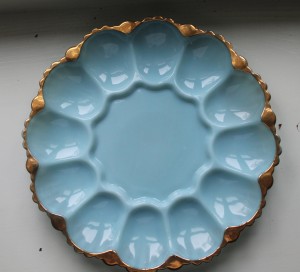
IMG_3560It seems appropriate to highlight this devilled egg tray over the weekend where eggs, albeit chocolate, are on the minds of lots of little ones.  I have a couple of these trays – one in peach lustre and this one in the delphite – and I have often marveled at the concept of a separate tray for eggs!  Although I must admit that it looks nice on the table with eggs on it!

I bought the book – Delphite & Jadite by Joe Keller & David Ross and learned a few interesting things:

  1.  That the opaque pieces of delphite/delfite/chaline are more expensive to collect, and harder to find than jadite, which I thought was expensive enough!
  2. Delphite was first introduced by McKee in the late 1920s.
  3. There are a number of distinct colours with chaline being a lighter, more vibrant shade of blue.
  4. Anchor Hocking’s pieces, produced under the Fire-King lines in the 1950s and 1960s were made in turquoise blue and azurite.  Azurite is a very pale blue which looks almost white in tint.IMG_3561

This tray is obviously Anchor Hocking’s turquoise.

This is a great book with lots of illustrations.  There are many pieces in both colours that I have never seen.

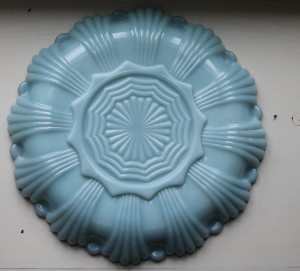
I love the fact that the bottom of the tray, although not seen when in use, has been so attractively fashioned.


← Older posts

♣ Categories

♣ Recent Comments

  • d.b. on Westmoreland Lovebirds Covered Dish
  • Pamela Smith on Westmoreland Lovebirds Covered Dish
  • d.b. on Cambridge Willow Etch
  • d.b. on Update to Bohemia Thistle Champagne – Thistle Bowl – Thistle Pitcher

♣ Grannys Glasses on Etsy

https://www.etsy.com/ca/shop/GrannysGlasses?ref=search_shop_redirect

Proudly powered by WordPress Theme: Chateau by Ignacio Ricci.